01
User endpoint
Runs the client used to access the application.
Size the network, servers and storage for the applications your team depends on.
Discuss a pilot at your site ↗
Operators reach the service through approved network segments. The server runs the application and reads its data from primary storage. A scheduled job writes a recoverable backup to the agreed destination. The team restores the service in an isolated environment, checks that it runs and verifies its data.
After the restore, open the application, check its data in the test environment and record the actual recovery time.
A workstation connects to a protected application. IT tests recovery in a separate environment.
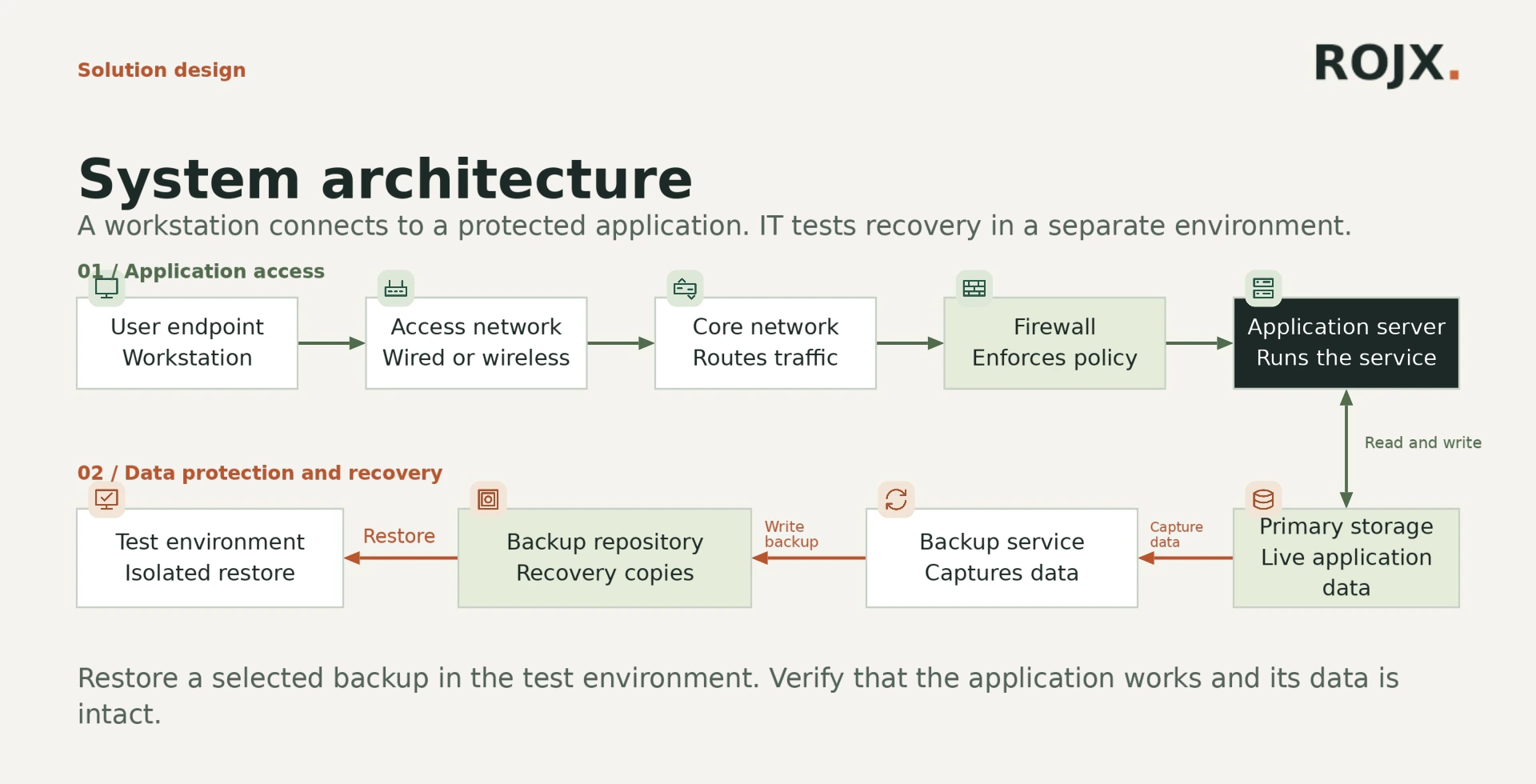
Runs the client used to access the application.
Connects wired and wireless devices to a network segment.
Routes traffic between approved network segments.
Permits or denies connections according to policy.
Runs the service and accesses its data.
Holds the data used by the live application.
Creates recoverable copies on a schedule.
Stores copies under separate access and retention rules.
Hosts the restored copy for verification.
Bring an application inventory, network diagram and service recovery priorities.
Discuss a pilot at your site ↗Restore an agreed application in isolation, open it, verify its data and record the actual recovery time.
Optical access is optional. Site design determines whether to use an optical line terminal, passive splitters and optical network terminals.
Application inventory, peak loads, network map, racks, power, cooling and recovery targets.